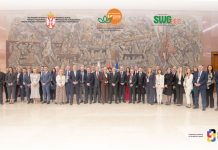
More than 45 participants, including agricultural advisors, ministry representatives and regional and national experts, gathered for the Second Regional Training on Climate Change Adaptation in Agriculture for Advisory Services, held on 28–30 October 2026 in Skopje, North Macedonia. The training was organised by the Regional Rural Development Standing Working Group in South Eastern Europe (SWG RRD), with the support of Deutsche Gesellschaft für Internationale Zusammenarbeit (GIZ), within the Climate Change Adaptation in Agriculture in the Western Balkans project.
The training provided a platform for sharing practical approaches to helping farmers respond to climate-related challenges. Opening remarks by Mr. Boban Ilic of the SWG Head Office/Secretariat were followed by presentations on the Climate Change Adaptation project by Mr. Darko Konjevic, SWG Head Office/Secretariat, and on the WB Adapt Project by a GIZ representative.
Regional expert Aleksandra Martinovska Stojcheska introduced the training manual, designed to translate climate adaptation knowledge into practical guidance for agricultural advisors. Through presentations, exercises and discussions, participants explored five thematic modules covering soil management, water management, crop production, livestock and the socio-economic aspects of climate change adaptation.
Regional case studies highlighted irrigation monitoring and water scarcity in Serbia, maize production under changing climatic conditions in Bosnia and Herzegovina, and the effects of extreme weather events on grain crop yields in North Macedonia. The exchanges focused on adaptation measures that can be applied at farm level.
On 30 October, participants visited Opitno Pole, the experimental fields of the Faculty of Agricultural Sciences and Food in Skopje, where climate change impacts on different crops are monitored and adaptation measures are studied in practice. Monitoring and research equipment at the site was funded through investments by GIZ and the Ministry of Education of North Macedonia.
The training reaffirmed the importance of stronger agricultural advisory capacities, continued regional cooperation and practical, farmer-oriented solutions to advance climate-resilient and sustainable agriculture across the Western Balkans.