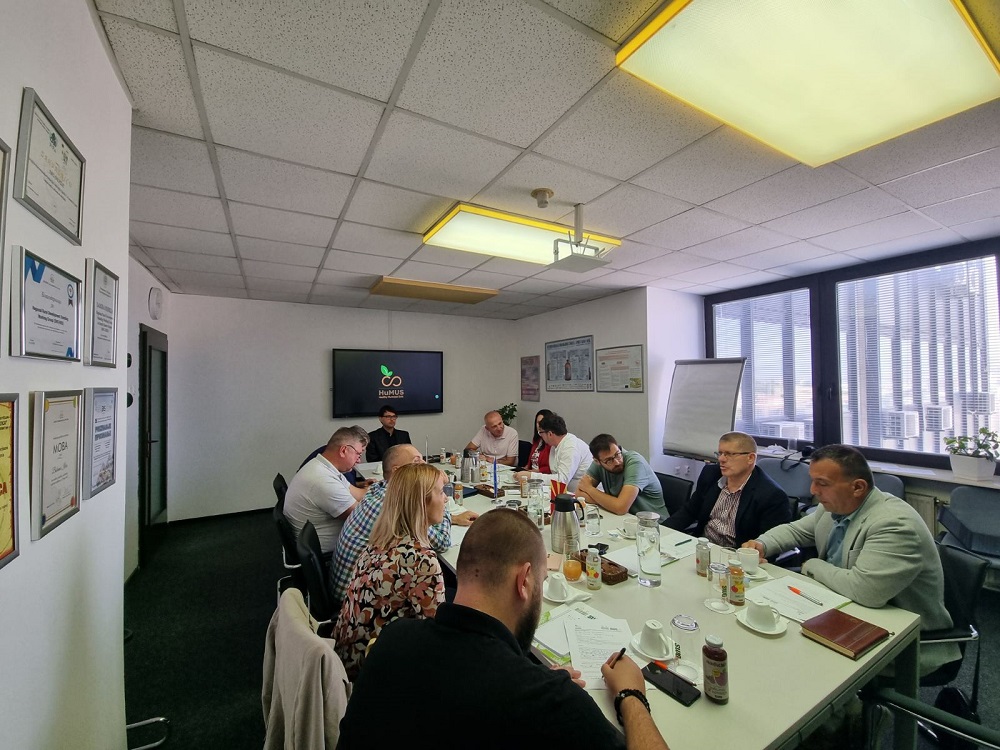
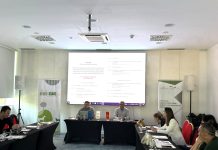
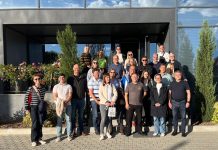
At the SWG RRD headquarters in Skopje, North Macedonia, on Thursday, 5th October 2023, was held the workshop with focus groups: HuMUS – healthy municipal soils, Task 1.2 – Regional-specific policies on soil health. At the workshop were invited representatives from: the Ministry of Agriculture, Forestry and Water Management of the Republic of North Macedonia, the Ministry of Environment and Spatial Planning of the Republic of North Macedonia, representatives of the University – professors who are experts in the area of soil, representative from the Agency for promoting the development of agriculture, representatives from the NGO sector – the National federation of farmers and the Association of agricultural cooperatives and representatives from the farmers and the foresters.
It was presented the HuMUS project with discussion regarding the data previously gathered through the online questionnaire. The presentation included a section on the establishment of Regional Soil Health Communities, and the participants were asked to provide feedback on which platform is suitable for discussion among the diverse stakeholders. There was a suggestion that a Europe wide platform for communication specifically for this purpose be created, similar to the other social media, but separate.
After the HuMUS project presentation, participants filled in the Focus group questionnaire, and the discussion was made. It was agreed that continuous dialogue and communication is needed and that efforts for its maintenance are going to be made.
Key messages from the stakeholders were:
- The vision and hope for the future of soils is that all key stakeholders recognize the fundamental importance of soils. To achieve this, we need to harness the potential of our fertile soils through proper utilization and management, which includes regular soil analysis and fertilization planning. By adopting sustainable practices, we can promote healthy soil and subsequently, healthy food production. This also involves investment in professional personnel, the removal of heavy metals, and remediation efforts. The aim is to create and implement policies that prioritize healthy soils, ensuring sustainability for future generations.
- State and regional cooperation among all institutions and stakeholders, creating joint policies.
- Living labs and lighthouses should be implemented.
- Creating action plans for: soil degradation prevention, soil management, soil monitoring.
The main hindering forces for soil health management in the region that the participants pointed out are lack of education and institutional unwillingness for cooperation, lack of centralized and decentralized policies and regulation that would be implemented.
Regarding the policy landscape the answers regarding the 4 categories were as follows:
- Eco-schemes at state level are available through the nation subsidies, however their distribution and intention are inadequate.
- Cross-compliance and conditionality (GAEC and SMR) exist only in strictly regulated markets such as organic production. Standards exist and are implemented only if the industry where they are implemented is under monitoring and revision.
- Rural development/Agri-environment measures – policies for polluters exist, but so far there were not any complaints to the Ministry of Environment and Spatial Planning regarding soil regulation, so the actual state from the field and the statistical state might not be unified.
- Municipal policies – there were not any that regulate specific policy which is according to the soil needs, such as banned pesticides or similar that differs from the national laws.
As a final conclusion was stated that the situation is urgent regarding the need for strategy and laws with the accent on soil degradation, soil monitoring and adequate management with incentives for the farmers/foresters.
HuMUS_Focus Group Presentation